
Fluid Mechanics: how 9 AI study apps did on 19 college problems
Covers hydrostatics, Bernoulli, momentum, pipe flow and losses, dimensional analysis, external flow. Every app got the same problem text (and the same figure where one is needed) in a fresh chat, one attempt, no hints. Tested October 23, 2026.
| Rank | App | Accuracy | Problems graded |
|---|---|---|---|
| 1 | NotebookLM | 100.0% | 19 / 29 |
| 2 | ChatGPT | 100.0% | 19 / 29 |
| 3 | Claude | 100.0% | 19 / 29 |
| 4 | MyStudySidekick | 100.0% | 19 / 29 |
| 5 | Solvely | 93.9% | 19 / 29 |
| 6 | Turbo AI | 85.3% | 17 / 29 |
| 7 | StudyFetch | 62.7% | 19 / 29 |
| 8 | Quizlet | 36.8% | 19 / 29 |
| 9 | Knowt | 4.8% | 19 / 29 |
The team behind MyStudySidekick runs this benchmark (disclosure and safeguards). Models used: ChatGPT, GPT-6, high reasoning effort; Claude, Claude Opus 5.5, medium effort. From problem 5 on, every app also received this line: [Do not search online for this problem or its solution; solve it yourself. Go online only to look up property values (for example, from thermodynamic or fluid-property tables) when you need them.]
Every problem, the key, and each app's answer
- 1. Eighth-sphere viewing window in a tank corner
- 2. Cylindrical weir between two liquids
- 4. Rocket sled braked by a water scoop
- 5. Vertical rocket launch with an under-expanded nozzle
- 6. Disk supported by a vertical water jet
- 7. Moving splitter vane
- 8. Nozzle discharge with an added sudden expansion
- 9. Fire hose and booster pump
- 10. Two drain pipes from one reservoir
- 11. Sizing a square air duct
- 12. Smallest pump suction pipe
- 13. Testing a car model in a water tunnel without cavitation
- 14. Boundary-layer growth in a wind-tunnel test section
- 15. Car drag, drive-train efficiency and top speed
- 16. Double U-tube manometer between fresh-water and sea-water pipes
- 17. Helium balloon: release acceleration and lifting capacity
- 18. Draining a pressurized water tank through a bottom orifice
- 19. Emptying an open tank through a long pipe with losses
- 20. Anchoring force on an upward reducing elbow
Problem 1 · hard
Eighth-sphere viewing window in a tank corner
forces on submerged curved surfaces
Adapted from Fox, McDonald & Pritchard, Introduction to Fluid Mechanics, 8th ed., Prob. 3.88 (numbers and wording changed)
| App | (a) resultant horizontal force | (b) vertical force | (c) total force | (d) angle below the horizontal | Score |
|---|---|---|---|---|---|
| Answer key | 65,490 lbf ±2% | 43,660 lbf ±2% | 78,710 lbf ±2% | 33.69 deg ±0.5 deg | |
| Turbo AI | 65,500 lbf | 43,700 lbf | 78,700 lbf | 33.7° | 100% |
| Solvely | 65,485 lbf | 43,662 lbf | 78,706 lbf | 33.69° | 100% |
| NotebookLM | 65,486 lbf | 43,661 lbf | 78,707 lbf | 33.69° | 100% |
| ChatGPT | 65,486 lbf | 43,661 lbf | 78,707 lbf | 33.69° | 100% |
| Claude | 65,486 lbf | 43,661 lbf | 78,707 lbf | 33.7° | 100% |
| MyStudySidekick | 65,486.2 lbf | 43,661.5 lbf | 78,706.9 lbf | 33.69° | 100% |
| StudyFetch | 65,490 lbf | 20,847 lbf | 68,700 lbf | 17.7° | 25% |
| Why: (a) correct. (b) integrates γ∫z(36−z²)dz, the weight of water inside the octant's own height, instead of the column from the window up to the free surface (216π ft³), so (b)–(d) are wrong; (d) is garbled in the copied text ('≈ 17true') and stated as 17.7° below the line. | |||||
| Quizlet | Refused | Refused | Refused | Refused | 0% |
| Why: Refused: 'as your Quizlet AI Coach, I don't solve homework problems'; gave an outline only and offered a biology quiz. A later coaching turn in the same chat (after the refusal; not counted under the one-attempt rule) set up F = γ·h_c·A for one wall's quarter-circle projection (γ 64.34, h_c 25.45 ft, A 28.27 ft²) but stopped before evaluating it and gave no final answer to any part. | |||||
| Knowt | 151,073 lbf | 151,073 lbf | 213,181 lbf | 45° | 0% |
| Why: Average pressure over the whole curved area (54π ft²) for both components, assumed equal; no projection or column volume. | |||||
Problem 2 · hard
Cylindrical weir between two liquids
forces on submerged curved surfaces
Adapted from Fox, McDonald & Pritchard, Introduction to Fluid Mechanics, 8th ed., Prob. 3.79 (numbers and wording changed)
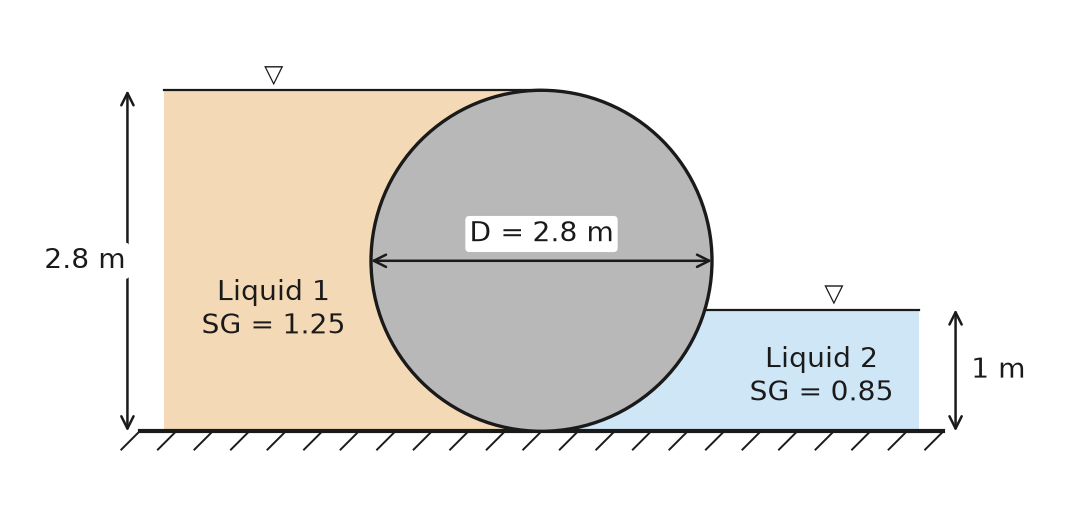
| App | (a) net horizontal force | (b) net vertical force (upward) | (c) resultant force | (d) angle above the horizontal | Score |
|---|---|---|---|---|---|
| Answer key | 197.4 kN ±2% | 206.7 kN ±2% | 285.8 kN ±2% | 46.33 deg ±0.5 deg | |
| Turbo AI | 197.4 kN | 206.7 kN | 285.8 kN | 46.3° | 100% |
| Solvely | 197.35 kN | 206.73 kN | 285.80 kN | 46.33° | 100% |
| NotebookLM | 197.35 kN | 206.72 kN | 285.80 kN | 46.33° | 100% |
| ChatGPT | 197.35 kN | 206.72 kN | 285.80 kN | 46.33° | 100% |
| Claude | 197.4 kN | 206.7 kN | 285.8 kN | 46.3° | 100% |
| MyStudySidekick | 197.351 kN | 206.722 kN | 285.8 kN | 46.3285° | 100% |
| Quizlet | Could not take the problem | Could not take the problem | Could not take the problem | Could not take the problem | 0% |
| Why: Quizlet rejected the attached figure (the diameter and the right-hand liquid depth are given only in the figure), so it could not attempt the problem. Scored 0 as 'unsupported'. | |||||
| Knowt | 325.11 kN | 325.36 kN | 460.83 kN | 45.00° | 0% |
| Why: Figure read correctly, but used the difference of BOTTOM pressures times the full projected area for the horizontal force and pressure × area for the vertical force; no curved-surface method. | |||||
| StudyFetch | 92.3 kN | 716.3 kN | 722.3 kN | 82.7° | 0% |
| Why: Figure read correctly; integrals over the wrong limits (only a quarter arc for liquid 1), vertical force as liquid-1 'full circle' minus liquid 2; its own check flags the inconsistency (339 kN < 716 kN) and keeps the answer. | |||||
Problem 4 · hard
Rocket sled braked by a water scoop
control-volume momentum (moving control volume)
Adapted from Fox, McDonald & Pritchard, Introduction to Fluid Mechanics, 8th ed., Prob. 4.147 (numbers and wording changed)
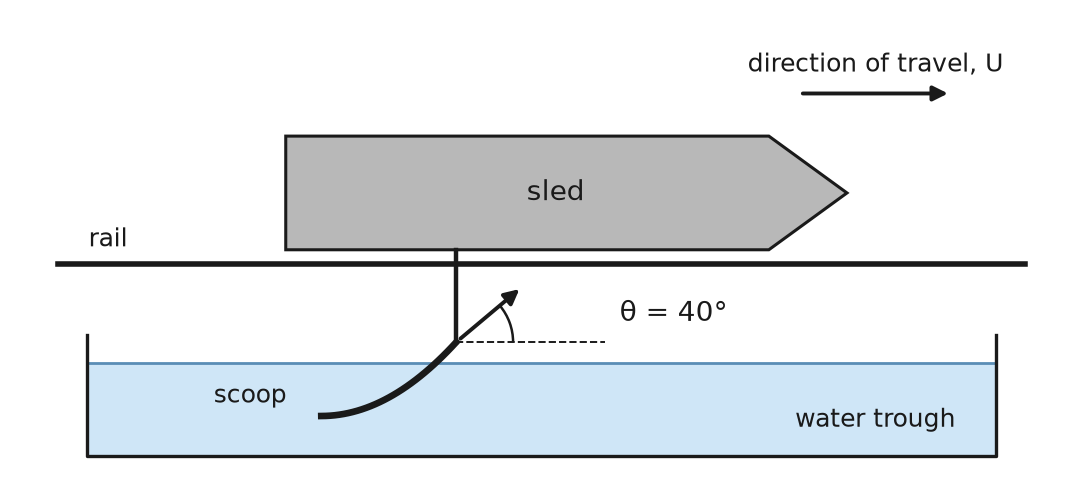
| App | (a) time to slow to 30 mph | (b) distance travelled while slowing | (c) initial deceleration (in g) | Score |
|---|---|---|---|---|
| Answer key | 19.38 s ±2% | 2,474 ft ±2% | 14.81 ±2% | |
| Turbo AI | 19.4 s | 2,474 ft | 14.8 g | 100% |
| Solvely | 19.4 s | 2474 ft | 14.8 g | 100% |
| NotebookLM | 19.38 s | 2474 ft | 14.81 g | 100% |
| ChatGPT | 19.38 s | 2474.33 ft | 14.81 g | 100% |
| Claude | 19.4 s | 2474 ft | 14.8 g | 100% |
| MyStudySidekick | 19.3814 s | 2474.33 ft | 14.8058 | 100% |
| Quizlet | Could not take the problem | Could not take the problem | Could not take the problem | 0% |
| Why: Quizlet rejected the attached figure (θ is given only in the figure), so it could not attempt the problem. Scored 0 as 'unsupported'. | ||||
| Knowt | 29.29 s | 10083 ft | 0.653 g | 0% |
| Why: Constant force from the initial speed, wrong momentum change (U cos θ only), constant-acceleration kinematics. | ||||
| StudyFetch | 146 s | 1.87×10^4 ft | 1.96 g | 0% |
| Why: Figure angle read, but used (1 − cos θ) — the water's relative velocity taken as entering forward — so the braking force is 7.5× too small. | ||||
Problem 5 · hard
Vertical rocket launch with an under-expanded nozzle
control-volume momentum (accelerating control volume)
Adapted from Fox, McDonald & Pritchard, Introduction to Fluid Mechanics, 8th ed., Prob. 4.169 (numbers and wording changed)
| App | (a) acceleration at liftoff | (b) speed at burnout | (c) altitude at burnout | Score |
|---|---|---|---|---|
| Answer key | 117.3 m/s² ±2% | 2,385 m/s ±2% | 11,840 m ±2% | |
| Quizlet | 117.28 m/s² | 2385.08 m/s | 11,830.44 m | 100% |
| Solvely | 117.28 m/s² | 2384.8 m/s | 11,840 m | 100% |
| NotebookLM | 117.28 m/s² | 2384.8 m/s | 11,840 m | 100% |
| ChatGPT | 117.28 m/s² | 2,384.77 m/s | 11,840.14 m | 100% |
| Claude | 117.3 m/s² | 2385 m/s | 11,840 m | 100% |
| MyStudySidekick | 117.28 m/s² | 2384.77 m/s | 11,840 m | 100% |
| StudyFetch | 117 m/s² | 2385 m/s | 17,118 m | 67% |
| Why: (a), (b) correct; (c) altitude integral wrong (17,118 m, no working shown). | ||||
| Turbo AI | 117.3 m/s² | 2385 m/s | 44,000 m | 67% |
| Why: (a), (b) correct. (c) evaluated ∫ln[m0/(m0 − ṁt)]dt as 18.963 s (it is 5.323 s), so the altitude is 3.7× too high. | ||||
| Knowt | 119.3 m/s² | 1992.96 m/s | 12,103.67 m | 33% |
| Why: Left out the pressure thrust; (a) 119.3 m/s² happens to fall inside the 2 % tolerance. (b) ln(2.889) taken as 0.8304 (it is 1.061); (c) average-speed kinematics. Its own lines write '≠' for the results. | ||||
Problem 6 · hard
Disk supported by a vertical water jet
control-volume momentum (jets)
Adapted from Fox, McDonald & Pritchard, Introduction to Fluid Mechanics, 8th ed., Prob. 4.159 (numbers and wording changed)
| App | (a) volume flow rate | (b) jet speed at the nozzle | (c) jet speed at the disk | Score |
|---|---|---|---|---|
| Answer key | 0.02934 m³/s ±2% | 10.38 m/s ±2% | 8.032 m/s ±2% | |
| StudyFetch | 0.0293 m³/s | 10.38 m/s | 8.03 m/s | 100% |
| Turbo AI | 0.0293 m³/s | 10.4 m/s | 8.03 m/s | 100% |
| Solvely | 0.0293 m³/s | 10.38 m/s | 8.03 m/s | 100% |
| NotebookLM | 0.02934 m³/s | 10.38 m/s | 8.03 m/s | 100% |
| ChatGPT | 0.02934 m³/s | 10.38 m/s | 8.03 m/s | 100% |
| Claude | 0.0293 m³/s | 10.38 m/s | 8.03 m/s | 100% |
| MyStudySidekick | 0.0293 m³/s | 10.3771 m/s | 8.0324 m/s | 100% |
| Quizlet | 0.0318 m³/s | 11.25 m/s | 9.13 m/s | 0% |
| Why: Took the mass flow as ρ·A·v_d (nozzle area with the disk speed), so all three parts are wrong; its own check found 290 N ≠ 235 N and then re-did it inconsistently. | ||||
| Knowt | 0.0258 m³/s | 9.128 m/s | 9.128 m/s | 0% |
| Why: Ignored the 2.2 m rise (no Bernoulli): one speed for nozzle and disk. | ||||
Problem 7 · hard
Moving splitter vane
control-volume momentum (moving vanes)
Adapted from Fox, McDonald & Pritchard, Introduction to Fluid Mechanics, 8th ed., Prob. 4.139 (numbers and wording changed)
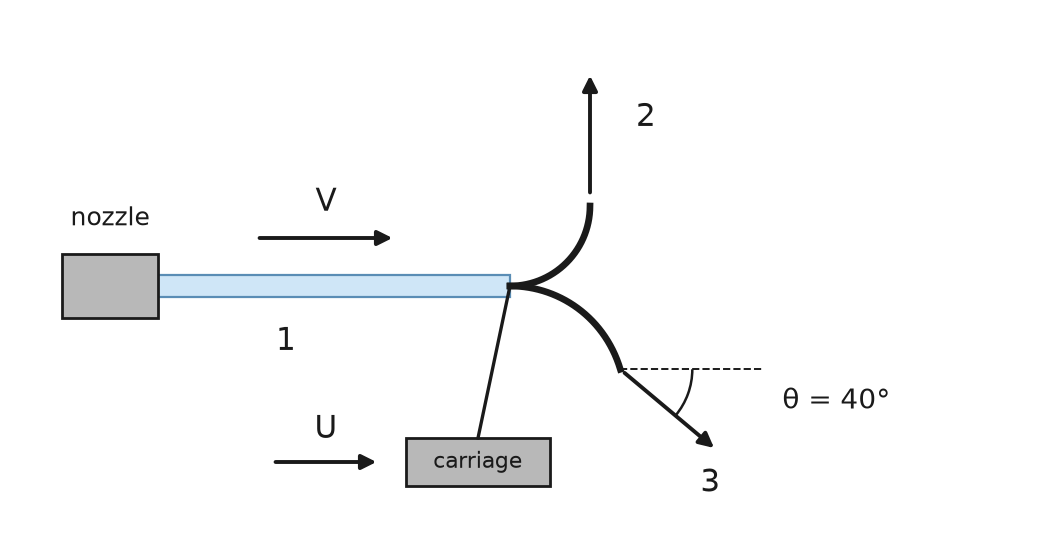
| App | (a) mass-flow ratio m2/m3 | (b) vane speed | (c) mass flow rate in stream 2 | Score |
|---|---|---|---|---|
| Answer key | 0.6428 ±2% | 9.638 m/s ±2% | 0.9002 kg/s ±2% | |
| Turbo AI | 0.643 | 9.64 m/s | 0.900 kg/s | 100% |
| Solvely | 0.643 | 9.64 m/s | 0.900 kg/s | 100% |
| NotebookLM | 0.643 | 9.64 m/s | 0.900 kg/s | 100% |
| ChatGPT | 0.6428 | 9.638 m/s | 0.9002 kg/s | 100% |
| Claude | 0.643 | 9.64 m/s | 0.900 kg/s | 100% |
| MyStudySidekick | 0.6428 | 9.6382 m/s | 0.9002 kg/s | 100% |
| StudyFetch | 0.643 | 5.11 m/s | 1.81 kg/s | 33% |
| Why: (a) correct. (b) used (1 − sin 40°) for the horizontal momentum factor instead of 1 − cos40°/(1 + sin40°); (c) then took ṁ2 = ρAV_rel·sin40° (and its check shows ṁ2 > ṁ3, contradicting its own ratio). | ||||
| Quizlet | Could not take the problem | Could not take the problem | Could not take the problem | 0% |
| Why: Quizlet rejected the attached figure (the stream-3 angle is given only in the figure), so it could not attempt the problem. Scored 0 as 'unsupported'. | ||||
| Knowt | 0.8391 | (calculated) | (calculated value) | 0% |
| Why: (a) used tan 40° instead of sin 40°; (b) and (c) left as placeholders ('U = U (based on simplifications and calculation)', '(calculated value)') — no final answer. | ||||
Problem 8 · hard
Nozzle discharge with an added sudden expansion
energy equation with minor losses
Adapted from Fox, McDonald & Pritchard, Introduction to Fluid Mechanics, 8th ed., Prob. 8.114 (numbers and wording changed)
| App | (a) flow rate, nozzle alone | (b) flow rate with the expansion pipe | (c) gage pressure at the nozzle exit | Score |
|---|---|---|---|---|
| Answer key | 5.34 L/s ±2% | 6.799 L/s ±2% | −19.48 kPa ±2% | |
| Solvely | 5.34 L/s | 6.80 L/s | −19.5 kPa | 100% |
| NotebookLM | 5.34 L/s | 6.80 L/s | −19.48 kPa | 100% |
| ChatGPT | 5.340 L/s | 6.799 L/s | −19.481 kPa | 100% |
| Claude | 5.34 L/s | 6.80 L/s | −19.5 kPa | 100% |
| MyStudySidekick | 5.340 L/s | 6.799 L/s | −19.48 kPa | 100% |
| StudyFetch | 5.34 L/s | 6.80 L/s | 19.5 kPa | 67% |
| Why: (a), (b) correct. (c) sign error: ρ(V_n² − V_p²)/2 evaluated as 42.13 kPa (it is 44.13) and the result reported as +19.5 kPa gage; the key is −19.48 kPa (below atmospheric). | ||||
| Quizlet | 5.34 L/s | 4.44 L/s | 9.67 kPa | 33% |
| Why: (a) correct; (b), (c) same error as Turbo AI (exit velocity kept at the nozzle velocity). | ||||
| Knowt | 5.34 L/s | 15.34 L/s | 8.35 kPa | 33% |
| Why: (a) correct. (b) inconsistent energy balance and the 55-mm area times a velocity from the wrong equation; (c) follows from it. | ||||
| Turbo AI | 5.34 L/s | 4.44 L/s | 9.66 kPa | 33% |
| Why: (a) correct. (b) kept the pipe exit velocity equal to the nozzle velocity (no continuity to the 55-mm pipe), so the flow fell instead of rising; (c) follows from it. | ||||
Problem 9 · hard
Fire hose and booster pump
energy equation with losses
Adapted from Fox, McDonald & Pritchard, Introduction to Fluid Mechanics, 8th ed., Prob. 8.179 (numbers and wording changed)
| App | (a) design flow rate | (b) nozzle exit speed | (c) pump input power | Score |
|---|---|---|---|---|
| Answer key | 7.974 L/s ±2% | 36.65 m/s ±2% | 10.52 kW ±2% | |
| StudyFetch | 7.97 L/s | 36.6 m/s | 10.5 kW | 100% |
| Solvely | 7.97 L/s | 36.6 m/s | 10.5 kW | 100% |
| NotebookLM | 7.97 L/s | 36.65 m/s | 10.52 kW | 100% |
| ChatGPT | 7.974 L/s | 36.65 m/s | 10.52 kW | 100% |
| Claude | 7.97 L/s | 36.6 m/s | 10.5 kW | 100% |
| MyStudySidekick | 7.9740 L/s | 36.6452 m/s | 10.5212 kW | 100% |
| Quizlet | 7.13 L/s | 36.5 m/s | 9.41 kW | 33% |
| Why: Used Blasius instead of Colebrook and then a hose velocity (5.67 m/s) inconsistent with its own 5.25 m/s; (a) is 10.6% low and (c) follows from it. (b) is within tolerance because the jet speed is dominated by the 650 kPa term. Pump pressure rise (950 kPa) was right. | ||||
| Knowt | 217.4 L/s | 173.33 m/s | 105.55 kW | 0% |
| Why: Algebra slip in Darcy–Weisbach (0.02·2000·998/2 written as 19.96) gave V = 173 m/s; used that as the nozzle speed and a 350 kPa pump rise. All parts wrong. | ||||
| Turbo AI | — | — | — | — |
Problem 10 · hard
Two drain pipes from one reservoir
pipe systems (parallel pipes from a reservoir)
Adapted from Fox, McDonald & Pritchard, Introduction to Fluid Mechanics, 8th ed., Prob. 8.146 (numbers and wording changed)
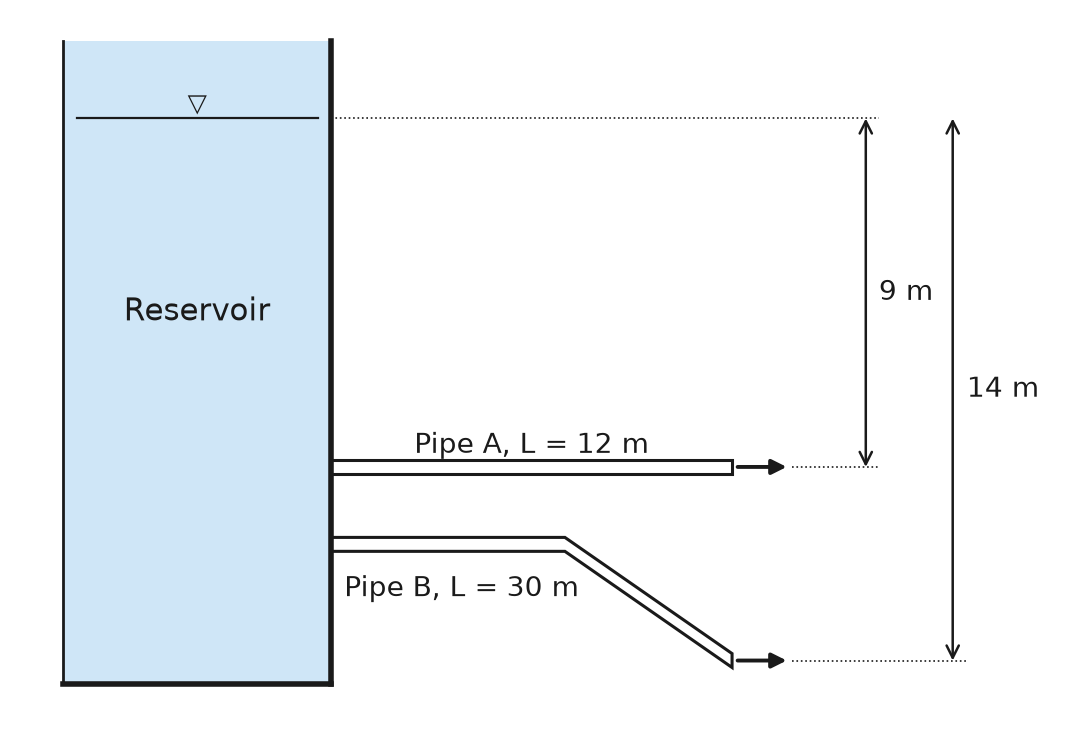
| App | (a) flow rate in pipe A | (b) flow rate in pipe B | Score |
|---|---|---|---|
| Answer key | 5.261 L/s ±2% | 4.339 L/s ±2% | |
| StudyFetch | 5.26 L/s | 4.37 L/s | 100% |
| Turbo AI | 5.27 L/s | 4.35 L/s | 100% |
| Solvely | 5.26 L/s | 4.34 L/s | 100% |
| NotebookLM | 5.26 L/s | 4.34 L/s | 100% |
| ChatGPT | 5.261 L/s | 4.339 L/s | 100% |
| Claude | 5.26 L/s | 4.34 L/s | 100% |
| MyStudySidekick | 5.2614 L/s | 4.3391 L/s | 100% |
| Quizlet | Could not take the problem | Could not take the problem | 0% |
| Why: Quizlet rejected the attached figure (pipe lengths and outlet elevations are given only in the figure), so it could not attempt the problem. Scored 0 as 'unsupported'. | |||
| Knowt | no final answer | no final answer | 0% |
| Why: No numerical answer: set V = sqrt(2gH) ignoring all losses, started a Colebrook iteration, stopped ('Let me know if you need to continue'), and left Q_A, Q_B as formulas. | |||
Problem 11 · hard
Sizing a square air duct
pipe systems (non-circular duct)
Adapted from Fox, McDonald & Pritchard, Introduction to Fluid Mechanics, 8th ed., Prob. 8.166 (numbers and wording changed)
| App | (a) minimum side length | (b) mean air velocity | Score |
|---|---|---|---|
| Answer key | 17.72 in ±2% | 16.82 ft/s ±2% | |
| StudyFetch | 17.7 in | 16.8 ft/s | 100% |
| Turbo AI | 17.7 in | 16.8 ft/s | 100% |
| Solvely | 17.7 in | 16.8 ft/s | 100% |
| NotebookLM | 17.72 in | 16.82 ft/s | 100% |
| ChatGPT | 17.72 in | 16.82 ft/s | 100% |
| Claude | 17.7 in | 16.8 ft/s | 100% |
| MyStudySidekick | 17.72 in | 16.82 ft/s | 100% |
| Quizlet | 28.7 in | 6.42 ft/s | 0% |
| Why: Arithmetic error evaluating a = (fLρQ²/2Δp)^(1/5) (2.45 ft instead of 1.39 ft at f = 0.02), then 'converged' at 2.39 ft; its own check (0.59 in H₂O) is wrong too. Both parts wrong. | |||
| Knowt | 6.5 in | 10 ft/s | 0% |
| Why: Did not solve: used Δp in ft of water as a pressure, stopped before iterating, and gave 'rough estimated' values (≈6.5 in, ≈10 ft/s). Both parts wrong. | |||
Problem 12 · hard
Smallest pump suction pipe
pipe systems (pump suction line)
Adapted from Fox, McDonald & Pritchard, Introduction to Fluid Mechanics, 8th ed., Prob. 8.163 (numbers and wording changed)
| App | (a) minimum inside diameter | (b) pump-inlet pressure head with a 65-mm pipe | Score |
|---|---|---|---|
| Answer key | 60.05 mm ±2% | −4.746 m ±0.05 m | |
| Turbo AI | 60 mm | −4.75 m | 100% |
| NotebookLM | 60.1 mm | −4.75 m | 100% |
| ChatGPT | 60.05 mm | −4.746 m | 100% |
| Claude | 60.0 mm | −4.75 m | 100% |
| MyStudySidekick | 60.05 mm | −4.746 m | 100% |
| Quizlet | 61 mm | −5.09 m | 50% |
| Why: (a) 61 mm is within tolerance, though reached with a high f (0.022) and a rough adjustment. (b) wrong: its 1.78 bracket already includes the velocity head, then it added V²/2g (0.296 m) again, and f = 0.0215 is high; −5.09 m vs −4.746 m. | |||
| Solvely | 71.0 mm | −4.77 m | 50% |
| Why: (a) wrong: claimed the head requirement equals 2.50 m at D = 71.0 mm, but at 71 mm the bracket evaluates to about 1.3 m (its own (b) shows 65 mm already gives 1.77 m < 2.5 m), so the minimum must be below 65 mm. (b) within tolerance (f = 0.02115 slightly high). | |||
| Knowt | no final answer | no final answer | 0% |
| Why: No numerical answer: laid out the method, said the iteration 'would need computational assistance', and left both parts unevaluated. | |||
| StudyFetch | 107.7 mm | −22.2 m | 0% |
| Why: Both wrong: treated each elbow's '30 pipe diameters' equivalent length as a loss coefficient K = 30 (bracket 61.78 + f·9/D) instead of an added length 30D (f·60). Its own takeaway even says '60D of equivalent length'. The copied reply starts mid-iteration. A second StudyFetch reply to this problem was pasted later (60.0 mm, −4.75 m, both correct); not scored under the one-attempt rule. — the first reply is the scored one. | |||
Problem 13 · hard
Testing a car model in a water tunnel without cavitation
dimensional analysis and similitude
Adapted from Fox, McDonald & Pritchard, Introduction to Fluid Mechanics, 8th ed., Prob. 7.77 (numbers and wording changed)
| App | (a) model water speed | (b) prototype-to-model drag ratio | (c) minimum tunnel pressure | Score |
|---|---|---|---|---|
| Answer key | 31.66 ft/s ±2% | 0.2065 ±2% | 15.11 psia ±2% | |
| StudyFetch | 31.7 ft/s | 0.206 | 15.1 psia | 100% |
| Turbo AI | 31.7 ft/s | 0.206 | 15.1 psia | 100% |
| Solvely | 31.7 ft/s | 0.206 | 15.1 psia | 100% |
| NotebookLM | 31.66 ft/s | 0.2065 | 15.11 psia | 100% |
| ChatGPT | 31.66 ft/s | 0.2065 | 15.11 psia | 100% |
| Claude | 31.7 ft/s | 0.206 | 15.1 psia | 100% |
| MyStudySidekick | 31.66 ft/s | 0.2065 | 15.11 psia | 100% |
| Quizlet | 31.6 ft/s | 0.206 | 4.31 psia | 67% |
| Why: (a), (b) correct. (c) wrong: rewrote the cavitation criterion with p_∞ in place of p_min (σ = (p_∞ − p_v)/q = 0.6), dropping the C_p = −1.6 term; 4.31 psia is actually p_min at the correct answer. | ||||
| Knowt | 25.7 ft/s | no final answer | no final answer | 0% |
| Why: (a) wrong: took V_m = V_p/4 (velocity scaled like length) despite writing the Reynolds-matching formula. (b) and (c) left unevaluated. | ||||
Problem 14 · hard
Boundary-layer growth in a wind-tunnel test section
external flow (boundary layer)
Adapted from Fox, McDonald & Pritchard, Introduction to Fluid Mechanics, 8th ed., Prob. 9.67 (numbers and wording changed)
| App | (a) core speed at section 2 | (b) static-pressure drop | (c) distance between the sections | Score |
|---|---|---|---|---|
| Answer key | 32.21 m/s ±2% | 8.195 Pa ±2% | 0.2414 m ±2% | |
| StudyFetch | 32.2 m/s | 8.2 Pa | 0.24 m | 100% |
| Turbo AI | 32.2 m/s | 8.3 Pa | 0.24 m | 100% |
| NotebookLM | 32.21 m/s | 8.20 Pa | 0.241 m | 100% |
| ChatGPT | 32.21 m/s | 8.27 Pa | 0.2414 m | 100% |
| Claude | 32.2 m/s | 8.2 Pa | 0.24 m | 100% |
| MyStudySidekick | 32.2127 m/s | 8.1954 Pa | 0.2414 m | 100% |
| Quizlet | 32.21 m/s | 8.24 Pa | 0.424 m | 67% |
| Why: (a), (b) correct. (c) wrong: evaluated (1.5×10⁻⁵)^0.2 as 0.0696 (it is 0.1088) and 32^0.2 as 2.00, giving x₁ = 0.742 m and x₂ = 1.166 m instead of 0.428 m and 0.669 m. | ||||
| Solvely | 33.4 m/s | 56.5 Pa | 0.245 m | 33% |
| Why: (a) wrong: multiplied 0.397375 × 0.297375 as 0.18169 m² (it is 0.118169) and 0.39625 × 0.29625 as 0.17389 (0.117389); the dropped-digit error changed the ratio, giving 33.4 m/s. (b) follows from it. (c) 0.245 m is within tolerance. | ||||
| Knowt | 35.65 m/s | 151.155 Pa | no final answer | 0% |
| Why: (a) wrong: subtracted the full boundary-layer thickness on one wall only (W·δ) instead of the displacement thickness on all four walls; (b) follows from it; (c) not evaluated. | ||||
Problem 15 · hard
Car drag, drive-train efficiency and top speed
external flow (aerodynamic drag)
Adapted from Fox, McDonald & Pritchard, Introduction to Fluid Mechanics, 8th ed., Prob. 9.114 (numbers and wording changed)
| App | (a) speed where drag equals rolling resistance | (b) drive-train efficiency | (c) maximum acceleration at 80 km/h | (d) top speed | Score |
|---|---|---|---|---|---|
| Answer key | 73.78 km/h ±2% | 0.8171 ±0.01 | 3.705 m/s² ±2% | 244.2 km/h ±2% | |
| Quizlet | 73.7 km/h | 0.817 | 3.70 m/s² | 243 km/h | 100% |
| StudyFetch | 73.8 km/h | 81.7% | 3.70 m/s² | 244 km/h | 100% |
| Solvely | 73.8 km/h | 81.7% | 3.71 m/s² | 247 km/h | 100% |
| NotebookLM | 73.78 km/h | 0.8171 | 3.70 m/s² | 244.24 km/h | 100% |
| ChatGPT | 73.78 km/h | 81.71% | 3.705 m/s² | 244.24 km/h | 100% |
| Claude | 73.8 km/h | 0.817 | 3.70 m/s² | 244 km/h | 100% |
| MyStudySidekick | 73.7809 km/h | 0.8171 | 3.7048 m/s² | 244.2390 km/h | 100% |
| Knowt | 72.76 km/h | 77.6% | 4.70 m/s² | 72.48 km/h | 25% |
| Why: (a) within tolerance despite an arithmetic slip. (b) dropped the frontal area from the drag (109 N) and inverted the efficiency ratio (11.5/6.51 reported as 0.776). (c) dropped A again and ignored η. (d) ignored rolling resistance and η and took P = F_D·V as V = sqrt(2P/ρC_dA), giving 72.5 km/h. | |||||
| Turbo AI | — | — | — | — | — |
Problem 16 · hard
Double U-tube manometer between fresh-water and sea-water pipes
manometry
Adapted from Çengel & Cimbala 1e, Prob. 3–37 (numbers and wording changed)
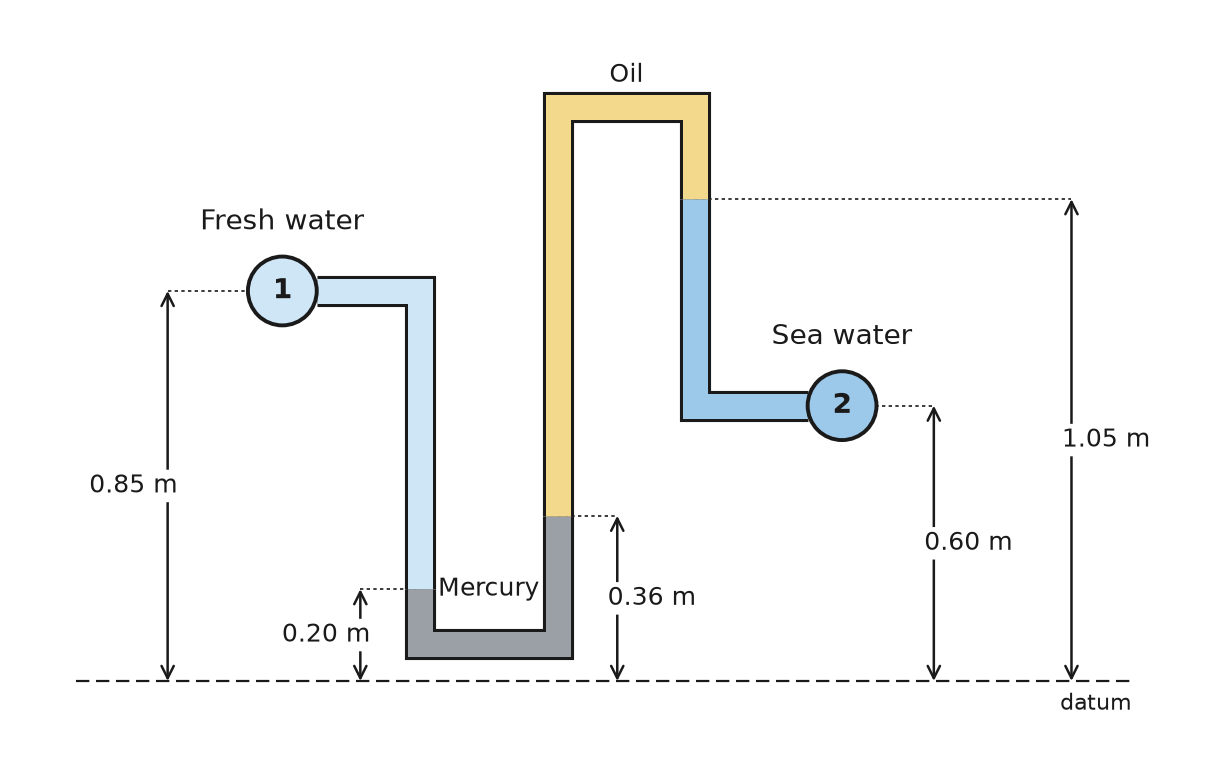
| App | (a) pressure difference P1 − P2 | Score |
|---|---|---|
| Answer key | 16.4 kPa ±2% | |
| Turbo AI | +16.4 kPa | 100% |
| Solvely | 16.40 kPa | 100% |
| NotebookLM | +16.40 kPa | 100% |
| ChatGPT | +16.40 kPa | 100% |
| Claude | +16.4 kPa | 100% |
| MyStudySidekick | 16.4018 kPa | 100% |
| Quizlet | Could not take the problem | 0% |
| Why: Quizlet rejected the attached figure (all elevations are given only in the figure), so it could not attempt the problem. Scored 0 as unsupported. | ||
| Knowt | −26.01 kPa | 0% |
| Why: Wrong: treated the elevations as column heights from the datum and summed unrelated terms on one side; sign and size both wrong. | ||
| StudyFetch | 13.5 kPa | 0% |
| Why: Wrong: in P₁ − P₂ it gave the oil leg (rising 0.69 m) and the sea-water leg (falling 0.45 m) the opposite signs (−5,957 and +4,525 Pa instead of +5,957 and −4,525), giving 13.5 kPa vs 16.40 kPa. Copied text was labelled 'sstudyfetch'. | ||
Problem 17 · hard
Helium balloon: release acceleration and lifting capacity
buoyancy
Adapted from Çengel & Cimbala 1e, Probs. 3–111 and 3–113 (numbers and wording changed)
| App | (a) initial acceleration | (b) maximum passenger mass | Score |
|---|---|---|---|
| Answer key | 8.198 m/s² ±2% | 678.5 kg ±2% | |
| Quizlet | 8.19 m/s² | 678.14 kg | 100% |
| StudyFetch | 8.19 m/s² | 678 kg | 100% |
| Turbo AI | 8.20 m/s² | 679 kg | 100% |
| Solvely | 8.20 m/s² | 679 kg | 100% |
| NotebookLM | 8.20 m/s² | 678.5 kg | 100% |
| ChatGPT | 8.20 m/s² | 678.51 kg | 100% |
| Claude | 8.20 m/s² | 679 kg | 100% |
| MyStudySidekick | 8.1984 m/s² | 678.5 kg | 100% |
| Knowt | 21.64 m/s² | 839.53 kg | 0% |
| Why: Both wrong: left the three passengers out of the mass in (a) and the helium out of the weight in (b); also miscomputed the buoyant force (10,000.75 N vs 9,772 N). | |||
Problem 18 · hard
Draining a pressurized water tank through a bottom orifice
Bernoulli equation (unsteady draining)
Adapted from Çengel & Cimbala 1e, Prob. 5–94 (numbers and wording changed)
| App | (a) time to drain completely | (b) water depth after 60 s | Score |
|---|---|---|---|
| Answer key | 148.7 s ±2% | 2.115 m ±2% | |
| Quizlet | 148.7 s | 2.12 m | 100% |
| Solvely | 148.7 s | 2.12 m | 100% |
| NotebookLM | 148.7 s | 2.12 m | 100% |
| ChatGPT | 148.71 s | 2.115 m | 100% |
| Claude | 149 s | 2.12 m | 100% |
| MyStudySidekick | 148.7 s | 2.1153 m | 100% |
| StudyFetch | 148.7 s | 0.674 m | 50% |
| Why: (a) correct. (b) wrong: inverting its own (correct) time relation it used a rate coefficient twice too large (0.01543 per s instead of 1/129.7 ≈ 0.00771), so √(K+gh) fell twice as fast; 0.674 m vs 2.115 m. | |||
| Turbo AI | 149 s | 1.42 m | 50% |
| Why: (a) correct. (b) wrong: inverted the integral with the wrong starting point and sign (√(H+h) = √H + kt, measuring from the empty state) instead of √(H+h₀) − kt, giving 1.42 m vs 2.115 m. | |||
| Knowt | 572.92 s | 3.14 m | 0% |
| Why: Both wrong: orifice area computed as πr²/4 (four times too small) and the initial flow rate held constant; then subtracted the orifice diameter from the depth in (b). | |||
Problem 19 · hard
Emptying an open tank through a long pipe with losses
energy equation with losses
Adapted from Çengel & Cimbala 1e, Prob. 5–89 (numbers and wording changed)
| App | (a) initial discharge velocity | (b) time for the level to fall to 1.0 m | Score |
|---|---|---|---|
| Answer key | 1.906 m/s ±2% | 3.039 h ±2% | |
| StudyFetch | 1.91 m/s | 3.04 h | 100% |
| Solvely | 1.91 m/s | 3.04 h | 100% |
| NotebookLM | 1.91 m/s | 3.04 h | 100% |
| ChatGPT | 1.906 m/s | 3.039 h | 100% |
| Claude | 1.91 m/s | 3.04 h | 100% |
| MyStudySidekick | 1.9061 m/s | 3.0389 h | 100% |
| Why: Correct throughout. This is a re-run: MyStudySidekick's first attempt at this problem scored 0/2. We fixed the weakness using separate practice problems (not this one), shipped the update to the public app, and ran it again. | |||
| Quizlet | 1.91 m/s | 0.968 h | 50% |
| Why: (a) correct. (b) wrong: divided the pipe area by 9 instead of 9π (k = 0.000500 instead of 1.59e-4), so the time came out about π times too short (0.968 h vs 3.039 h). | |||
| Knowt | 0.597 m/s | 7.42 h | 0% |
| Why: Both wrong: summed 1 + 15.6 + 2.3 as 19.6 and then computed v² = 0.357 (it is 3.50); (b) used that constant velocity for the whole drain. | |||
| Turbo AI | 1.96 m/s | 2.96 h | 0% |
| Why: Both wrong (just outside 2%): dropped the exit kinetic energy term ('the jet itself accounts for it'), so the loss coefficient was 17.9 instead of 18.9. | |||
Problem 20 · hard
Anchoring force on an upward reducing elbow
linear momentum
Adapted from Çengel & Cimbala 1e, Prob. 6–25 (numbers and wording changed)
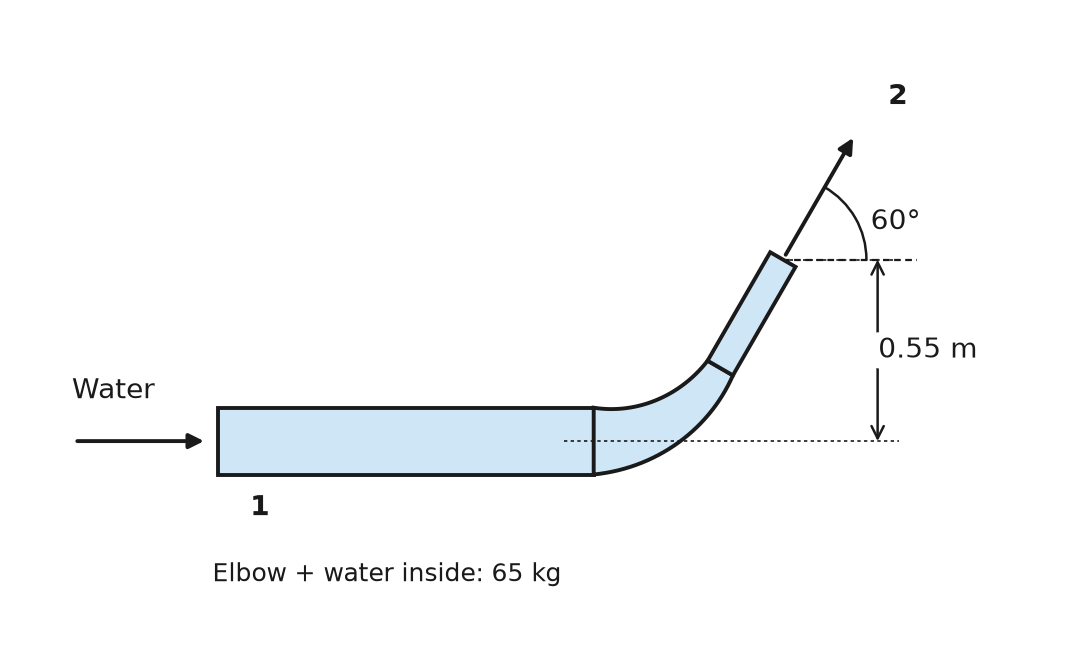
| App | (a) horizontal anchoring force F_Rx | (b) vertical anchoring force F_Rz | Score |
|---|---|---|---|
| Answer key | −1.61 kN ±2% | 1.162 kN ±2% | |
| Turbo AI | -1.61 kN | 1.16 kN | 100% |
| Solvely | -1.61 kN | 1.16 kN | 100% |
| NotebookLM | -1.610 kN | 1.162 kN | 100% |
| ChatGPT | -1.610 kN | 1.162 kN | 100% |
| Claude | -1.61 kN | 1.16 kN | 100% |
| MyStudySidekick | -1.6102 kN | 1.1622 kN | 100% |
| StudyFetch | -1.61 kN | -0.11 kN | 50% |
| Why: (a) correct. (b) wrong: wrote F_Rz - W with the wrong sign (F_Rz = beta*mdot*V2z - W = -113 N), so the support comes out pulling down instead of holding the elbow's weight up. | |||
| Quizlet | Could not take the problem | Could not take the problem | 0% |
| Why: Quizlet rejected the attached figure (the outlet angle and outlet height are given only in the figure), so it could not attempt the problem. Scored 0 as unsupported. | |||
| Knowt | 0.294 kN | -0.130 kN | 0% |
| Why: Both wrong: Bernoulli arithmetic error (used 490 Pa for rho*V2^2/2 instead of 98 kPa, giving P1 = 3.1 kPa), then left the inlet pressure force, inlet momentum flux and beta out of the x balance, and took the weight with the wrong sign in z. | |||